How Thermal Imaging Can Help Your Plumbing? - Surrey
Got a hunch there's a leak somewhere in your home, but you can't find it? You're not alone. Hidden plumbing problems are one of the most frustrating and potentially costly issues Surrey homeowners face, and the traditional approach of tearing open walls to find them isn't exactly ideal. That's where thermal imaging comes in. At Plumbing Surrey, it's one of the tools we use to find problems fast and fix them cleanly.
Quick take: Thermal imaging is a non-invasive diagnostic tool that uses infrared cameras to detect temperature differences on walls, floors, and ceilings, helping plumbers pinpoint hidden leaks, heating faults, and moisture problems without unnecessary damage to your property. In this blog, we'll cover how it works, what problems it can find, what to look for in a thermal camera, and the honest limitations you should know about before relying on it.
Table of Contents
What Is Thermal Imaging and How Does It Work in Plumbing?
Why Plumbers Use Thermal Imaging: Key Benefits and Use Cases
Common Plumbing Problems Thermal Cameras Can Help Detect
Choosing the Right Thermal Camera for Plumbing Work
Limitations, Accuracy, and Best Practices for Interpreting Thermal Images
What Is Thermal Imaging and How Does It Work in Plumbing?
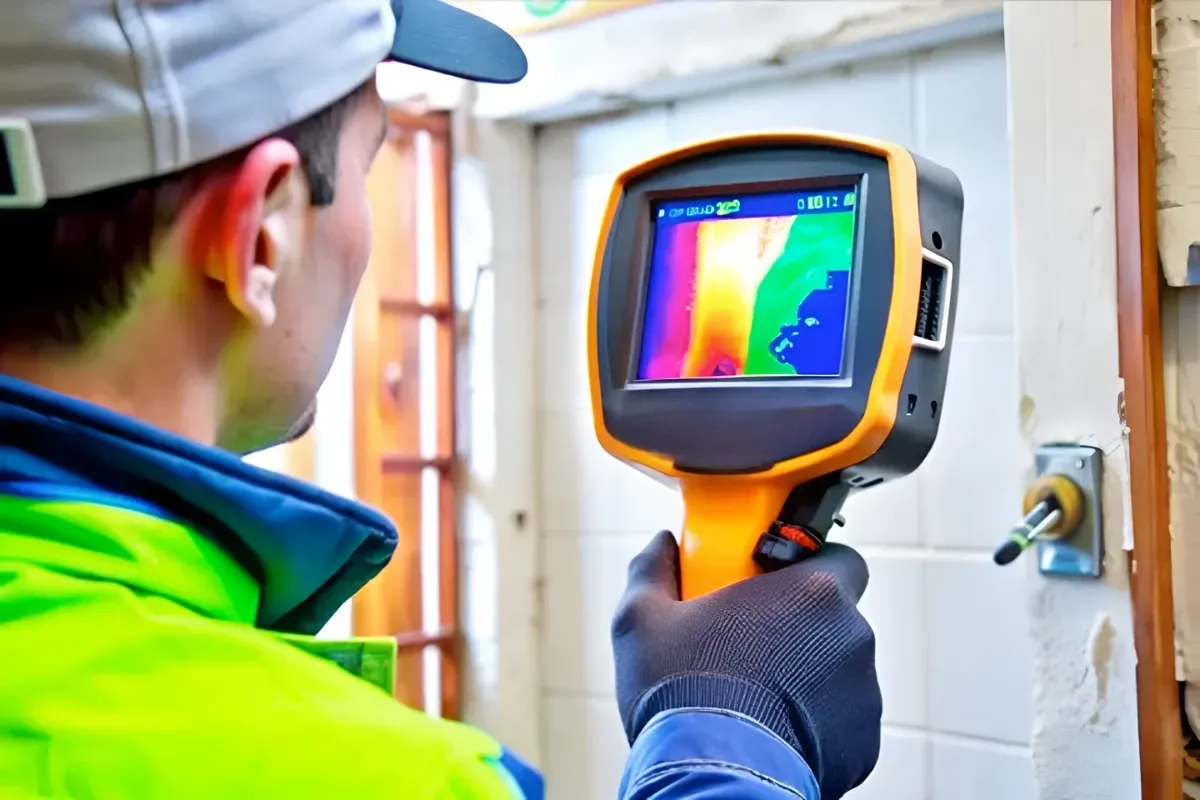
Thermal imaging, or infrared thermography, is a technology that detects heat energy emitted by objects. Everything above absolute zero gives off infrared radiation, including your walls, pipes, and floors. A thermal camera picks up those heat emissions and converts them into a colour-coded image called a thermogram, where warmer areas appear as brighter colours and cooler areas show up as darker or bluer tones.
In plumbing, this matters because water leaks and heating faults create temperature anomalies on surrounding surfaces. A hot water pipe leaking behind a wall will warm the plasterboard around it, while a cold water leak will create a cooler, damp patch. The thermal camera captures these surface temperature differences and shows the plumber exactly where to look.
It's worth being clear: thermal imaging doesn't see through walls like X-ray vision. It reads surface temperatures and identifies where heat is conducting through from the other side. But in the right conditions, that's often all a skilled plumber needs to locate a problem without causing unnecessary damage to your home.
Why Plumbers Use Thermal Imaging: Key Benefits and Use Cases
There are good reasons why thermal imaging has become a standard diagnostic tool among professional plumbers. Here's what makes it genuinely useful.
Non-invasive diagnosis. Instead of cutting into walls or lifting floorboards to track down a leak, a plumber can scan the surface and identify the likely source in a matter of minutes. That means less mess, less disruption, and targeted repairs rather than exploratory demolition.
Speed and efficiency. A thermal scan can cover a large area quickly. What might take hours of manual investigation can often be narrowed down to a specific zone within a single inspection. For homeowners in Guildford or Woking dealing with a suspected hidden leak, that speed makes a real difference.
Early detection. Thermal imaging can catch problems before they become visible. A slow drip behind a wall won't show up as a damp patch for weeks, but the slight temperature change it causes can show up on a camera scan much sooner. Catching it early means smaller repairs and less risk of water damage or mould.
Documentation. Plumbers can save thermographic images before and after repairs, giving clients clear visual evidence of both the problem and its resolution. Particularly useful for insurance claims or landlord records.
Common Plumbing Problems Thermal Cameras Can Help Detect
Thermal imaging has a wide range of applications in plumbing. These are the most common issues it helps to identify.
Hidden pipe leaks. The most frequent use. Whether it's a hot water supply line or a cold feed, a leaking pipe behind a wall or beneath a floor creates a distinct thermal signature. Hot leaks show as warm patches; cold leaks create cooler, damp zones. Both can be spotted without opening up the building fabric. It's a common call-out for our teams in Sutton and Epsom.
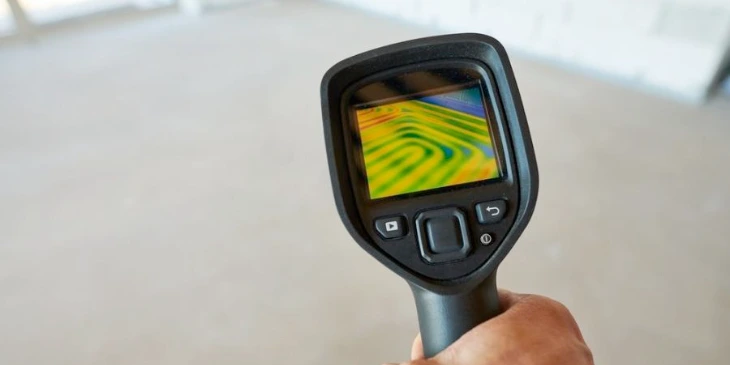
Radiant floor heating faults. When the system is running, the network of pipes beneath the floor shows up clearly on a thermal camera. Any break or leak appears as an irregular cool spot interrupting the expected pattern. Radiant faults can be located with minimal disruption to the floor surface.
Radiator and central heating issues. A properly functioning radiator should be evenly warm from top to bottom. Trapped air or sludge shows as a hot upper section and a cool lower section, confirming whether bleeding or flushing is needed. This is a particularly common issue in older properties across Reigate and Camberley.
Moisture intrusion and damp. Wet materials lose heat faster than dry ones, so damp areas show up as cooler patches on a thermal scan. This can help trace hidden moisture in a Surrey property, particularly in older Victorian or Edwardian homes in areas like Farnham and Dorking where pipework is less accessible.
Insulation gaps near pipes. Thermal cameras can identify cold spots around pipe runs in exterior walls, helping homeowners address poor insulation before it causes a burst in colder months. It's worth having this checked in any Redhill property with older external pipework.
Thermal Imaging Problem Detection at a Glance
Choosing the Right Thermal Camera for Plumbing Work
If you're a plumber considering investing in a thermal camera, here are the key factors that matter.
Resolution. The more thermal pixels the sensor has, the clearer the image. For plumbing work, a resolution of 320×240 or above gives you the detail needed to identify small leaks or narrow pipe runs behind walls.
Thermal sensitivity. Expressed as NETD, this tells you the smallest temperature change the camera can detect. For plumbing, a sensitivity of around 0.05°C (50 mK) or better ensures the camera won't miss a faint moisture signature.
Focus. Adjustable focus allows the camera to produce sharp images at varying distances, which is especially useful when focusing on a specific pipe joint or in a confined space.
Durability. Thermal cameras used in plumbing end up in loft spaces, under kitchen units, and in cramped airing cupboards. A rugged, lightweight build matters.
Imaging software. The ability to narrow the temperature span manually, save images, and overlay thermal readings on a standard photograph makes findings far easier to communicate to clients. Find out more about how we work on our about page.
Limitations, Accuracy, and Best Practices for Interpreting Thermal Images
Thermal imaging is a powerful tool, but it's not infallible. Here's an honest look at what it can and can't do.
It only reads surfaces. The camera measures temperature at the surface of a wall or floor. If a leaking pipe is buried deeply or is well-insulated, its temperature may not conduct to the surface at all, meaning the camera will show nothing. Deep-set pipework can remain invisible even when actively leaking.
Reflective surfaces can mislead. Shiny tiles, chrome fittings, and polished surfaces can reflect infrared from other sources, including the body heat of the plumber holding the camera. This can create false hotspots that have nothing to do with the plumbing behind them.
Environmental interference. Sunlight warming an exterior wall, a recently switched-off radiator, or a draught from a window can all produce temperature patterns that resemble plumbing faults. Outdoor surveys are best carried out at night or early morning, and indoor scans work best when the room has been stable for a period beforehand.
Temperature is not the same as moisture. A cold patch on a thermal image could be a leak, but it could also be a gap in the wall insulation or a cold air draught. The camera detects temperature differences, not water. That's why thermal findings should always be followed up with a moisture meter or physical investigation to confirm the cause.
Best practices for accurate results:
Run hot water through the system before scanning to maximise temperature contrast
Adjust the camera's temperature span manually so subtle differences stand out
Scan slowly; look for linear streaks suggesting pipe runs, or diffuse cloud shapes suggesting moisture
Always verify a thermal anomaly with a moisture meter before assuming what's behind the wall
Cover shiny surfaces with paper or cloth to minimise reflective interference
Key Camera Spec Comparison
Final Thoughts on Thermal Imaging for Plumbing
Thermal imaging has genuinely changed how skilled plumbers diagnose problems. The ability to scan a wall, spot a temperature anomaly, and target a repair without tearing apart a room is a real benefit for homeowners and tradespeople alike. It saves time, reduces unnecessary damage, and gives clients something they can see and understand.
That said, the technology is only as good as the person using it. A cold patch isn't automatically a leak; a warm streak isn't always a pipe. The best results come when thermal imaging is used alongside other tools and a proper physical inspection. If you think there's a problem hiding somewhere in your Surrey home, get in touch and we'll take a look.
Thermal Imaging for Plumbing FAQs
Can thermal imaging cameras see through walls or floors?
Not exactly. A thermal camera detects surface temperature differences rather than seeing through solid walls. If a hot pipe is warming the plasterboard behind it, the camera will show a warm zone on the surface. If the pipe is too deep to affect surface temperature, the camera won't reveal anything. It reads thermal patterns, not physical structures.
Can a thermal camera detect water leaks behind walls?
Yes, and it's one of the most effective tools for doing so. A hidden cold water leak creates a cool, damp patch on the wall surface; a hot water leak creates a warm one. Findings should always be confirmed with a moisture meter before any major work is carried out.
Can thermal imaging detect mould or areas of potential mould growth?
Not directly, but it can find the conditions that lead to mould. Wet materials appear as cool patches in a thermal scan. By identifying hidden moisture early, a plumber can address the root cause before mould takes hold.
Will a thermal camera work on cold water leaks, or only hot water?
Both. Thermal imaging works wherever there's a temperature difference. A cold water leak cools the surrounding material, creating a detectable cooler zone against a warmer background. Both hot and cold leaks leave a thermal trace.
Is thermal imaging alone enough to confirm a plumbing leak?
It's a powerful locating tool, but not a standalone confirmation. What looks like a leak could also be a draught or a missing patch of insulation. Always follow up with a moisture meter reading or a small physical inspection before committing to major repair work.
Do I need a specialist to interpret thermal images, or can anyone do it?
Basic cameras are intuitive to operate, but reading images correctly takes practice. False positives, reflections, and environmental factors can all mislead an untrained eye. For a Surrey homeowner, it can give useful hints, but you'll want a professional plumber experienced in thermography to confirm anything before walls come down.
